

Post UNGA 2026 World Report: When Consequences Cross Borders Faster Than Coordination - The Inevitable Multipolar World Needs to Define Coherent & Responsible Sovereignty Without Fence Sitting

(10/3/2026) HAM Team / DT TRIO Labs - GVLN PEACELAND, Inc. (dba KXB BIOVERSE). the birthplace of Meta Innovations and the STEAMATIC Era [Science, Technology, Engineering, Arts, Mathematics, Automated, Tangible, Integrated, and Coherent] where infrastructure meets diplomacy and capital powers global trade culture.
A question being asked:
What Kind of Operating Architecture Does an Increasingly Volatile and Fragmented World Actually Require When Consequences Cross Borders faster than coordination?
20 years in the making,
Humanity 7.0 = Interoperable Sovereignty · वसुधैव कुटुम्बकम् –
One Earth Across Sovereign Border Lines
The Global Operational Standards Architecture
Powered by 7GIR-OS (operating system + Integration + Synchronization) + G-Trade
(finance) + GCIGS (governance + council) + BIOME (human dignity + cultural + experiential)
Emerged As the Frontrunner
against a gap with no equivalent working architecture
CONTENTS
Chapter 1 - Why This Report: The Coherence Deficit
Chapter 2 - UNGA 2026 – The World Speaks
Chapter 3 - The World As Is - Outside The Room: The Risk Environment
Chapter 4 - The Decade of Human Achievement
Chapter 5 - The New World of Superintelligence And Multipolarity
Chapter 6 - Humanity 7.0 - The Proposed Architecture
Chapter 7 - Operational Integration of The Proposed Architecture
Chapter 8 - SITREP Applied to Four Crossings
Chapter 9 - Annextures
A. SITREP 2026
B. Humanity 7.0 abridged
C. The Evidential Vault (193 + 5) 198 UNGA 2026 voices
D. The Seven-Domain Search
E. The Decade of Secretarial Diagnostics
F. Additional Sources, Disclaimers, Acknowledgements
Chapter 10. Closing and Thank You Note
CHAPTER 1 - WHY THIS REPORT
The Coherence Deficit: A 360-Degree Spatial Audit
Primary Sources: The Coherence Deficit & SITREP 2026
UNLIKE ANY YEAR IN THE RECENT PAST, 2026 HOLDS PROGRESS AND WRECKAGE IN THE SAME PICTURE. IT IS THE EXHIBIT YEAR THE 360-DEGREE WORLD CAMERA.
What standard international reporting consistently misses is the macro-critical reality that cross-border consequences no longer respect the administrative boundaries of the rooms built to manage them. A localized war in one geography instantly reprices energy grids, maritime shipping lanes, grain corridors, and insurance premiums in another. A national tariff or an export control measure rapidly rewires entire global supply networks. Strategic energy reserves are released while a vital maritime strait remains contested; global trade volumes expand while the legal basis of national measures fractures; localized peace texts are signed while operational verification arrives too late or fails entirely. The contemporary world is institutionally dense yet operationally segmented - a severe, structural coherence deficit.
Most official international reports stay inside one room. The WTO writes trade. The IMF writes money. The IEA writes energy. The UN writes peace, development and humanitarian work. Each can be competent inside its mandate and still miss the event that is no longer inside that mandate.
This report exists to look at that crossing and beyond. It is organized by consequence, not institutional turf. A war in one geography reprices energy, shipping, grain and insurance in others. A national tariff rewires several supply chains. A financial decision in one center changes liquidity and currency exposure in another. A pathogen, a model weight, or a cable cut does not wait for the competent committee to convene.
The contemporary world is already organized through sovereign states, specialized institutions, treaties, markets, infrastructure and tightly coupled technologies. Those arrangements produced extraordinary trade, mobility, finance, communication and development. The same coupling now transmits disruption through the same pipes that transmit opportunity. Interdependence is not a slogan. It is a transmission system. The missing piece is an operating protocol at the point where a consequence leaves the room in which it began. That missing piece is the coherence deficit.
The governing question of this report is narrow, testable, and urgent: does a working mechanism exist - anywhere in the current international system - that can reliably act when a consequence crosses the border of the state, sector, or institution where it began? Not a mechanism on paper. One that functions at the moment it is needed, regardless of which state is involved.
Tested across seven domains - peace and security, trade, sanctions and export controls, climate, health, education, and global poverty - the historical record reveals a recurring defect:
A nominal mechanism exists on paper.
The power to compel has been removed, deferred, or omitted.
Reform thresholds are blocked or left uncleared.
Workarounds produce administrative process more often than a binding, verifiable result.
Where a mechanism was actually built for the job, coordination moves at speed. The record already shows that contrast: an IEA stock action within eleven days of a Strait of Hormuz closure; a Security Council text on Gaza within five weeks. Beside those sit the other timestamps: a tariff instrument that changed legal basis three times in a few months while multilateral appellate review has been unavailable since December 2019; a peace text whose verification terms arrived weeks later; a roadmap that did not move while famine was confirmed. The point is not the scoreboard of any one file. The point is the pattern. Speed exists inside some rooms. Coherence fails at the crossing.
What the world is lacking outside the hall
Three conditions now sit in the same picture.
Operational segmentation. Mandate-rich machinery, result-poor coupling. The rules that set the pace of response are older than the velocity of the shocks.
Extreme economic divide. The Institute for Economics and Peace puts the economic impact of violence at US$21.8 trillion in 2025 - 10.5 percent of world output.
Military expenditure absorbs 43 percent of that load. Peacebuilding and peacekeeping absorb about 0.5 percent of military spending.
Peacefulness has deteriorated every year since 2014.
UCDP recorded 65 state-involved conflicts in 2025, the highest in a series that begins in 1946 - eight of them interstate, up from two in 2023.
The divide is the split between what the world spends to fight and what it spends to stop fighting; between capitals that can insure a shock and populations that absorb it as hunger, displacement and lost school years.
Multipolar drift. Power has multiplied and unaligned. More centres can veto, delay, duplicate or route around a common procedure. That is a thicker field with fewer shared operating standards. In a multipolar field without interoperability, every crossing becomes a negotiation, and every negotiation arrives after the consequence has already moved.
What the world therefore lacks is not another diagnosis. It lacks a working cross-border protocol that can sit across sovereign lines without abolishing them: sovereignty intact, and still able to act when the event has already left the territory, the sector, or the institution of origin.
Why this report
The existing multilateral architecture has struggled to contain the scale and velocity of global violence because its bounded, institutional rooms are structurally suited to matters that stay inside them, and structurally weak at the crossing where consequences do not.
2026 is not the origin of the deficit. It is the exhibit. Conflict, trade, energy, finance, health, education and technological transformation are interacting across sovereign and institutional boundaries in the same calendar year, in public, at once. That concentration is why the year can be read as a 360-degree camera rather than a single crisis file.
The missing piece is not another academic diagnosis. It is a functioning, cross-border protocol that sits across sovereign lines without abolishing them: sovereignty intact, and capable of a defined response the moment an event leaves its territory of origin. This report offers a candidate operating architecture for that crossing, set out in Chapters 6 through 8.
What the camera also keeps missing is the other half of the record: the human achievement that continues, and is then buried under geopolitical weight. The year is not empty of progress. It is a year in which progress is not permitted to become the story. Capacities are built. They are not allowed to compound. That is the heavier fact this report opens on.
The year ran through three stages that mirror how the world talks to itself.
Davos, January 2026
World Economic Forum, 56th Annual Meeting, theme “A Spirit of Dialogue”; Summer Davos, Dalian, “Innovating at Scale.” Meeting record: weforum.org/meetings/
BRICS
18th BRICS Summit, New Delhi, 12–13 September 2026, “Building for Resilience, Innovation, Cooperation and Sustainability.” New Delhi Declaration as issued by the chair. Record: brics2026.gov.in/
81st UNGA
22–28 September 2026, annual summit. Record: un.org/en/high-level-week-2026. Conflicts, price shocks, and famines do not respect the administrative boundaries of the rooms built to manage them. The structural deterioration of global peacefulness has continued since 2014. That is the world Chapter 3 goes on to describe outside the room, and the record Chapter 2 sets out from inside it.
CHAPTER 2
UNGA 2026 - THE WORLD SPEAKS
High-level week is the first evidentiary lens of what the world said about itself, in its own words, in the one room where every sovereign state had its voice on record. The President of the General Assembly is Khalilur Rahman of Bangladesh; it was the final opening address of Secretary-General António Guterres's term, which ends 31 December 2026.
Under the theme "Restoring trust, managing transformation: A United Nations that delivers for all," the assembly served less as a springboard for unified global action and more as a mirror reflecting a deeply fractured world order.
The 81st session of the General Assembly concluded against a backdrop of polarization showcasing the split between diplomatic rhetoric and realities of global conflicts.
Key Outcomes include
Calls for Peace and Action: Closing the debate, General Assembly President Khalilur Rahman noted that world leaders confronted a global landscape defined by active conflicts, stalled development, growing inequality, and rapid technological shifts, while reaffirming that the UN remains an indispensable platform.
Dominant Geopolitical Tensions: The general debate highlighted severe divisions surrounding ongoing global crises, including the Russia-Ukraine war, the Israel-Gaza conflict, and US-Israel-Iran tensions.
Questions on Relevance and Reform: Multiple leaders openly challenged the efficacy of the UN and a deadlocked Security Council in halting contemporary wars. Calls intensified from various member states (including India and African nations) for sweeping reforms, such as permanent seats on the UN Security Council, alongside debates over institutional cost-cutting and future leadership selection as Secretary-General António Guterres prepares to transition out.
Commitment to Cooperation: Despite deep-seated polarization, member states and regional bodies continued to stress the necessity of multilateral cooperation, the UN Charter, and collective frameworks to address climate action, pandemic preparedness, and sustainable development.
The hall did not speak with one mouth. It did speak, repeatedly, to the same pressure: trust thin, crossings live, machinery slower than the shock, human dignity eroding, tolerance diminishing, a stagnant podium and the gap between rhetoric and reality, shadow of unchecked conflict, battle for institutional relevance, shadow of leadership transition and the clamor for reform reaching a crescendo.
The UNGA lens
The roster held 198 entries: 193 member states, the Secretary-General, the President of the Assembly, Palestine as a non-member observer state, the Holy See and the European Union.
The demand for Security Council reform ran across every region and every register. Alexander Stubb of Finland proposed that no single state should hold a veto and independently corroborated the UCDP's count of 65 armed conflicts. Recep Tayyip Erdoğan of Turkey went further, calling for the veto abolished outright and declaring "the world is bigger than five." Subrahmanyam Jaishankar of India argued that "those most impacted often have the least say" in a system still shaped by 1945, and Ronald Lamola of South Africa, jointly with Brazil, Norway and Spain, pressed for an International Panel on Inequality modelled on the IPCC. Emmerson Mnangagwa of Zimbabwe placed the same complaint in financial terms: developing countries face a financing gap exceeding $4 trillion under machinery still built for outdated geopolitical realities of 1945.
Three voices defended the institutions built to hold power accountable, directly answering criticism raised elsewhere in the hall. Rob Jetten of the Netherlands told the Assembly "hands off the ICC," offering to host a Special Tribunal for the Crime of Aggression against Ukraine. Micheál Martin of Ireland backed the Court in the same terms, warning that what has happened in Gaza "will shame the world" when fully known. Vivian Balakrishnan of Singapore struck a more constructive note, affirming that "the multilateral system... still remains the best way to uphold global peace" even as he pressed for binding AI rules.
On artificial intelligence, the range ran from urgency to caution. Balakrishnan warned that AI capabilities are "developing faster than the world's understanding of the risks." Han Zheng of China took a narrower view, backing reform that would "strengthen - not cut" existing bodies while amplifying the Global South's voice, without touching the Council's permanent structure.
The chokepoint crisis reached the hall from every angle. King Abdullah II of Jordan gave it the sharpest single illustration in the record: "just look at the energy and grocery bills of ordinary families, from Mumbai to Madrid to Minnesota." Abdullatif bin Rashid Al Zayani of Bahrain, whose country led Security Council resolution 2817 on the issue, said the UN needs "not more resolutions, but a greater capacity to implement them." Hassan Sheikh Mohamud of Somalia gave the human cost a number: an estimated 40 percent fall in his country's customs revenue, borne by a state with no stake in the conflict at all.
The financial-architecture complaint had its own distinct voices. Mulambo Haimbe of Zambia framed his country's "Grow Zambia Agenda" as investment sought on fair terms, not charity. Mia Mottley of Barbados called the deeper failure "a crisis of responsibility" - not a lack of knowledge, but a failure to act on it - and proposed standing UN mediation teams deployed before conflicts entrench. Philip Davis of the Bahamas put it most starkly: a system where rules bind only the weak "is a hierarchy, not an order," and pressed for reparatory justice alongside it.
Not every complaint pointed the same direction. Janez Janša of Slovenia argued the UN's attention runs unevenly the other way, giving Gaza disproportionate focus while Ukraine, Belarus and Nigeria go comparatively unheard. Vasile Tofan of Moldova, with Russian troops still on Moldovan soil, drew the sharpest line on sovereignty itself: Countries are not buffer zones. Nations are not bargaining chips.
Two voices offered something closer to a working answer than a grievance. Espen Barth Eide of Norway named a "triple crisis" - normative, financial, institutional - opening with Gramsci's line that "the old world is dying, and a new world struggles to be born: now is the time of monsters." Anthony Albanese of Australia, speaking two days after the United States dismissed climate and AI concerns from the same podium, pointed to his own country's under-16 social media law, now followed by more than twenty others, as evidence that governance can still move faster than the problem. Sugiono of Indonesia closed the register on its most measured note: "Indonesia continues to believe in the UN, but believing in the United Nations also means believing that it must evolve with the world it serves.“
Decisions that are not carried out. The most repeated complaint concerned execution, not design. The DRC’s prime minister said the world needs no new texts, only the implementation of those adopted. Bahrain asked for “not more resolutions, but a greater capacity to implement them.” Haiti’s prime minister said “a mandate is not enough” for a force still below its planned strength. Barbados called it a failure to convert what is known into what is done. Bolivia, Togo, Rwanda and Uzbekistan made the same point in their own terms.
Who carries the cost. Finance was the second constant. Ghana called the global financial architecture weighted against Africa. Kenya said capital “must price risk. It must not price prejudice.” Madagascar, Comoros, Saint Vincent and the Grenadines, Saint Kitts and Nevis, Micronesia and Belize asked that financing follow vulnerability and not income per head. South Africa, with Brazil, Norway and Spain, pressed for an International Panel on Inequality modelled on the IPCC. The Solomon Islands noted that the world spent more than US$2.9 trillion on militaries last year, sixteen times official development assistance.
The routes trade depends on. The Strait of Hormuz, Bab al-Mandab and the Red Sea were named by Saudi Arabia, Kuwait, Bahrain, Djibouti, Yemen, Pakistan, Iraq and Brazil. Oman offered to mediate. Bahrain led Security Council resolution 2817 and tabled a Chapter VII draft on shipping. The cost landed on actors with no part in the fighting: Somalia’s president reported a 40 percent fall in customs revenue, the Philippines reported seafarers killed, Iraq proposed energy links to bypass the strait, and Kazakhstan condemned drone attacks on its oil export facilities.
A technology moving faster than its rules. The Secretary-General named artificial intelligence as one of four tests. The Holy See, Austria and Slovakia each objected to lethal decisions delegated to machines. Singapore, the Czech Republic and Greece asked for binding or licensed rules. Albania proposed a compact on sovereign and democratic AI, and Lesotho reported piloting the UN blueprint for national AI and data strategies. Rwanda, Malaysia and Jamaica asked that developing countries help set the rules. Argentina and the United States rejected pre-emptive regulation. Chapter 4 sets out this record.
Small states and the sea. The Assembly adopted a political declaration on sea-level rise the day before Tuvalu’s prime minister spoke. Tuvalu, the Marshall Islands, Mauritius, Fiji, the Bahamas, Saint Kitts and Nevis and Cabo Verde asked that statehood, borders, maritime zones and UN membership survive rising seas. Older claims surfaced alongside: the Marshall Islands asked for a UN apology for 67 nuclear tests during its trusteeship, Mauritius called Chagos sovereignty non-negotiable, and the Bahamas, Saint Vincent and Belize asked for reparatory justice.
Rules applied unevenly. Bulgaria, Bosnia and Herzegovina, Belgium, Cyprus, North Macedonia, Cambodia and the Bahamas said rules apply differently to small and large states. Hungary said allies cannot be held to another standard. Slovenia argued the reverse: that the UN attends to Gaza at the expense of Ukraine, Belarus and Nigeria. Mauritania noted that Palestinians were still refused a seat in the hall.
The wars argued from both sides. The files taken up in Chapter 7 in this report were each argued in the hall by the parties. Zelenskyy asked that Russia be held responsible and trade with it limited; Lavrov said the operation would be carried through to the end and proposed a new Eurasian security architecture. Netanyahu defended unilateral military action; Abbas said the danger threatens the existence of the Palestinian people and that promised plans had not materialized. Sharif warned that diversion of river waters would be treated as an act of war; Jaishankar named a “serial practitioner of terrorism.” Kuwait, Bahrain and Saudi Arabia described Iranian attacks on Gulf states; Iran’s president said Iran is open to dialogue. Armenia and Azerbaijan each described de facto peace since August 2025, and each raised its missing persons.
Moments in the hall. Reports say 77 delegations left during Netanyahu’s address; Tonga and Jamaica said they did not walk out. Iceland’s foreign minister turned his phrase back on those who refuse to negotiate. Croatia and Serbia contested the same history from the same podium. Belize’s prime minister reported an incursion by a Guatemalan military aircraft on 23 September; Guatemala’s foreign minister had spoken the day before about the pending ICJ hearing. Australia’s prime minister spoke two days after the US president on climate and AI. These are recorded as moments. None changes the pattern.
Not everyone accepted the premise. Argentina called the organization useless. The United States said it cut the UN budget by 15 percent and that there will be no global government. Colombia criticized UN bureaucracy, and Niger rejected outside models of governance. Russia proposed a parallel architecture. Singapore, Indonesia and Gambia defended multilateralism while asking it to evolve.
1. Khalilur Rahman, President of the General Assembly“Outside these walls, people are not asking whether the United Nations still exists. They are asking whether it works.” Trust, he said, is not given. It is earned. Endurance is not enough.
2. António Guterres, Secretary-General“The fault lines in our world are widening. Cracks have become canyons.” He named four tests of power: war and peace; concentrated wealth and inequality; climate and the war on nature; artificial intelligence. Superpowers were told their power is not so super. A Security Council without permanent African representation, he said, is unjust and indefensible.
3. Luiz Inácio Lula da Silva, President of BrazilFirst national speaker, by tradition. The UN, he said, is failing in its mission to spare humanity the scourge of war; credibility has never been so low; “we are all held hostage by the inaction of the Security Council.” The Strait of Hormuz had become a trench of war when it should have remained a passage for trade. “Brazil does not fit in anyone’s backyard.” He also named an unforgivable failure if big technology and AI remain without rules.
4. John Dramani Mahama, President of Ghana“Security Council reform is not a favor to Africa; it is an imperative for the legitimacy, credibility and survival of the United Nations.” The same demand ran through other African statements in the week - Ezulwini, two permanent seats, a Council still cut to 1945.
5.Taneti Maamau, President of KiribatiOn a crossing that is physical: sea and shore. Trust, he said, is not restored by words. It is strengthened through implementation, accountability and results that improve lives. In the same sitting, island states put sea-level rise on the record as an existential load, not a side meeting.
6. Javier Milei, President of Argentina — the adversarial counterweight. Calls the organization "useless," warns of taking the Falklands into Argentina's "own hands." Without this, the chapter reads as if everyone wants the UN fixed; Milei is the one voice saying the premise itself is wrong.
7. Balendra "Balen" Shah, Prime Minister of Nepal — "Glaciers and floods do not travel with a visa stamped on passports." The single most quotable line in the whole vault, and it states this report's own governing thesis in human terms, with over 1,300 dead and Guterres's own unheeded Everest warning as the frame.
8. Cardinal Pietro Parolin, Holy See — AI and lethal autonomous weapons specifically: "the decision to use lethal force cannot be delegated to opaque or automated processes." A non-political-bloc voice, distinct register from Lula's tech complaint.
9. William Ruto, President of Kenya — "Capital must price risk. It must not price prejudice." The sharpest financial-inequality line in the vault, backed by hard numbers (debt at $102 trillion, 46 countries spending more on debt than classrooms).
10. Mohamad Hasan, Foreign Minister of Malaysia — "We are sick of it." The most visceral single line on veto frustration, paired with a constructive Global South framing ("we must help shape those choices"), giving the chapter genuine emotional range alongside its diplomatic register.
The hall keeps returning to a short list: war that does not end; a Council that does not represent; climate and sea that do not wait; technology that outruns rule; a public that asks whether the house works. Annex C holds all the voices.
Ultimately, UNGA 2026 did not deliver the sweeping breakthroughs required to "restore trust." Instead, it functioned as a vital pressure valve and a sobering reminder that while the United Nations cannot easily stop modern wars, it remains the only global forum where a fractured world still gathers to talk.
On September 22nd, 2026, the United States told the General Assembly it would use “superintelligence” rather than “artificial intelligence”; an executive order to that effect was signed on 29 September. This report records the fact. It does not treat the rename as the definition.
The world outside this room is the next chapter.
CHAPTER 3
THE WORLD AS IS - Outside the Room
The Risk Environment
General Assembly gives the world a room in which sovereign nations can speak. Outside that room, consequences continue to move.
Conflicts, rivalry, trade frictions, energy exposure, monetary optionality, and technology acceleration accumulated over years. As sovereign options are widening, operating realities dictates that a localized conflict instantly transforms into active transmission chains. IMF in 2026 characterized the global environment as more fragmented, multipolar setting where largest macro-structural transformations interact.
Wars continue while negotiations proceed. Trade continues while tariffs, restrictions and strategic policies alter its pathways. Energy systems remain interconnected through grids, pipelines, shipping routes and critical materials. Food insecurity crosses the boundaries between conflict, agriculture, transport and humanitarian access. Climate impacts intersect with water, infrastructure, migration and public finance. Health and education continue to expand human capability while substantial gaps in access remain.
This chapter is therefore not a counterargument to the voices heard at UNGA 2026. It is the report’s second evidentiary lens:
What the world says about itself inside the room must be read beside what the world is actually carrying outside it.
The record is neither one of universal failure nor uninterrupted progress. It is a world in which resilience and disruption are occurring simultaneously.
1. Conflict - Consequences Travel Beyond the Battlefield
The global conflict burden remains historically severe. The Uppsala Conflict Data Program recorded 65 state-based armed conflicts in 2025, the highest number in its dataset beginning in 1946. Eight were interstate conflicts, 13 reached UCDP's threshold for war, and approximately 244,600 people were killed in organized violence during the year.
Those figures describe the kinetic event.
They do not describe its entire consequence.
A modern conflict can become, almost simultaneously:
displacement · humanitarian crisis · energy disruption · shipping disruption · food insecurity · trade disturbance · infrastructure failure · fiscal pressure
The geography of war and the geography of consequence are therefore no longer necessarily the same.
Food insecurity makes that connection particularly visible.
The 2026 Global Report on Food Crises found that acute food insecurity remained widespread during 2025. For the first time in the report's ten-year history, famine was confirmed during the same year in parts of both the Gaza Strip and Sudan, with famine risk continuing in Gaza, Sudan and South Sudan in 2026.
Food itself illustrates why consequences cannot always be managed within one institutional category.
A harvest may be local. The fertilizer may not be. The fuel may not be. The shipping corridor may not be. The financing may not be.
And the humanitarian consequence may move far beyond the geography in which the original disruption began. Conflict therefore demonstrates a recurring condition of the contemporary world: one event can enter several systems at once.
2. Economic Interdependence - Resilience Under Strategic Pressure
The world economy remains deeply interconnected.
World merchandise-trade volume grew 4.6 percent in 2025. The WTO's March 2026 baseline projected slower but still positive merchandise-trade growth of 1.9 percent in 2026. Total world goods and services trade reached approximately $34.65 trillion in 2025.
That is not the profile of a global economy that has ceased to function.
But the conditions under which economic interaction occurs are becoming more complex.
Tariffs, export controls, national-security measures, industrial policy and supply-chain realignment can affect sourcing, investment and production networks far beyond the jurisdiction in which a particular measure originates.
Trade can therefore remain resilient in aggregate while the routes, rules and strategic calculations surrounding it become less settled.
Finance presents a related challenge. National currencies remain national. Financial institutions remain differently regulated. Payment systems and settlement infrastructures remain institutionally distinct. Yet international commerce requires those environments to interact continuously.
The emerging challenge is therefore not simply whether one financial or trading system will replace another. It is how multiple systems can coexist and transact without requiring political, monetary or institutional uniformity. The world economy increasingly presents an interoperability problem: different systems, continuing economic interaction.
3. Physical Systems - Energy, Climate, Food and Oceans
Some of the world's most consequential systems are physical before they are political.
Energy: Energy illustrates this directly. Electricity generation cannot be separated from transmission, grid stability, storage, maintenance, financing, critical materials and complementary capacity. Renewable generation has expanded rapidly, but variable sources such as wind and solar require increasingly flexible grids, storage, transmission and other balancing resources. At the same time, the technologies supporting that integration continue to improve. IRENA reports that the installed cost of utility-scale battery-storage systems fell 93 percent between 2010 and 2024, from $2,571 per kilowatt-hour to $192 per kilowatt-hour. Hybrid renewable-and-storage systems are increasingly being deployed to improve reliability and grid balancing. The relevant question is therefore not simply whether one energy technology succeeds or fails. It is whether the whole energy system-generation, transmission, storage, resources, maintenance and infrastructure-is coherent enough to deliver reliable energy. Physical chokepoints reveal another dimension of that interdependence. In 2025, an average of approximately 20 million barrels of oil per day, around one quarter of global seaborne oil trade, moved through the Strait of Hormuz. Approximately 19 percent of global LNG trade also transited the Strait. A narrow physical corridor can therefore carry economic consequences for countries thousands of miles away. Energy is simultaneously: infrastructure · trade · national security · industrial capacity · and human necessity.
Climate and Adaptation: Climate presents a similar systems problem.
Heat, drought, flooding, water stress and sea-level rise intersect with agriculture, health, infrastructure, insurance, migration and public finance. International climate mechanisms have expanded substantially, but adaptation capacity remains highly uneven. UNEP estimates that developing countries will require approximately $310–365 billion annually for climate adaptation by 2035. International public adaptation-finance flows to developing countries were approximately $26 billion in 2023—placing estimated needs at roughly 12 to 14 times current flows.
The important condition is not that climate governance is absent.
It is the continuing gap between:
recognition and capacity, planning and financing, global exposure and local ability to absorb the consequence.
The physical environment does not organize itself according to ministerial boundaries.
Climate pressure can become agricultural pressure.
Agricultural pressure can become food pressure.
Food pressure can become economic and humanitarian pressure.
That is precisely the systems interaction this chapter is intended to expose.
Food
Food security sits at the intersection of many of these same systems.
It depends upon:
agriculture · water · energy · fertilizer · transport · trade · currency stability · conflict conditions · humanitarian access · household purchasing power
Food security is therefore not merely an agricultural issue.
It is an operating condition produced by several systems functioning together.
Oceans and the Blue Economy
The ocean presents perhaps the clearest physical example of multiple institutional domains occupying one continuous environment.
Oceans carry maritime trade.
They provide food through fisheries.
They support tourism and coastal livelihoods.
They host energy infrastructure.
They carry communications cables.
Ports connect maritime systems to inland logistics, industry and population centers. Coastal communities simultaneously confront environmental and climate pressures. UN Trade and Development estimates that trade in ocean-related goods and services exceeded $2.5 trillion in 2025, with services accounting for most of that trade.
The blue economy is therefore not merely an environmental category. It occupies the intersection of:
trade + food + infrastructure + climate + energy + sovereignty + human livelihood.
For coastal and island societies, those relationships are not theoretical. They are central to economic and national life.
Across energy, climate, food and oceans, the recurring reality is the same:
the physical system can already be integrated even when the institutions responsible for its different parts are not.
4. Human Capability - Health and Education
The world outside the room is also the other side of the same world of substantial human progress. Health systems have expanded. Education has reached populations on an unprecedented scale in earlier generations. Scientific and technological capability continues to grow. But access remains uneven.
Health
WHO and the World Bank report that global access to essential health services has improved over time. Yet an estimated 4.6 billion people lacked full coverage of essential health services in 2023, while 2.1 billion people experienced financial hardship from out-of-pocket health spending in 2022.
Health is not simply a domestic social-service category. And it is not the absence of diseases as they cross borders today.
Medicines and medical supply chains cross borders. Health professionals migrate.
Research, vaccines, diagnostics and health information move internationally.
Health capacity therefore intersects with economic resilience, mobility, productivity and human security.
Education
Education presents a comparable dual reality.
UNESCO reports that approximately 1.4 billion students were enrolled in school in 2024, reflecting major long-term expansion. Yet approximately 273 million children and young people remained out of school, and progress in reducing exclusion has slowed significantly since 2015. Education is more than a social indicator.
True education is the hallmark to RAISE THE BAR for responsible citizenship and wealthy societies: Where able governance with flourished trade and intelligent people maintain the equilibrium of man-made advancements with the available abundance of natural resources for healthy Planet.
It determines how societies absorb technology, develop skilled workforces, sustain research, increase productivity and distribute opportunity.
Health and education therefore belong to the operating capacity of societies themselves.
They are part of global resilience.
And where access remains inadequate, they are part of structural vulnerability.
One World Under Simultaneous Load
The world outside the room is therefore not one story.
It is several realities occurring simultaneously.
Conflict has intensified while the global economy has demonstrated considerable resilience.
Trade continues while strategic economic friction changes its pathways.
Energy systems are transitioning while remaining constrained by physical infrastructure and geography.
Climate planning is expanding while adaptation capacity remains uneven.
Global food systems connect local agriculture to international energy, finance, logistics and conflict.
A multi-trillion-dollar ocean economy connects trade, food, communications, energy and coastal societies.
Health and education continue advancing while substantial human-capability gaps remain.
The international environment itself is also changing. In July 2026, the IMF described global order becoming more fragmented and multipolar, while emphasizing that the world economy had remained remarkably resilient. It also noted that major geopolitical, technological and economic transformations are occurring simultaneously and interacting with one another.
That combination matters. Systems are still working. Trade still moves. Institutions still coordinate. Technology still advances.
Energy systems continue evolving. Health and education continue improving lives. Capital continues crossing borders.
The conclusion is therefore not that every existing institution has failed. Nor is it that the world lacks functioning systems. The condition is more specific: systems which remain separately organized are increasingly exposed to consequences that arrive together.
War becomes energy.
Energy becomes prices.
Prices become food insecurity.
Trade becomes supply-chain strategy.
Climate becomes infrastructure and mobility pressure.
Health becomes economic resilience.
Education becomes technological capability.
Oceans become trade, food, climate and sovereignty simultaneously.
The world is interconnected not because every nation has chosen political integration, but because consequence itself has become interconnected.
That is The World As Is.
And one technological capability is now moving through almost every one of these systems with unusual speed, scale and reach.
It deserves examination on its own terms that found a new identity and a new name that just entered the world which we are defining in Chapter 5.
CHAPTER 4
THE DECADE OF HUMAN ACHIEVEMENT
Artificial intelligence included - the name that stayed for decades
This chapter records what the decade actually put into the world. It is not a claim that every laboratory hope became infrastructure. Institutional rooms fractured while capability compounded. The deficit is not a shortage of tools. It is a shortage of a stable crossing on which those tools can be hosted.
1. Compute and artificial intelligence Protein-structure prediction moved from a slow experimental craft to a computational one. The AlphaFold Protein Structure Database, hosted by EMBL-EBI, holds predicted structures across the human proteome and related sets, with confidence that varies by residue and by protein.
Machine systems moved from narrow pattern-matching to tools that draft code, text, image, and operating procedures inside limits set by their builders. They remained tools. They did not become sovereigns. The governance record of that capability - the range of positions at the 81st session, the Security Council briefing of 23 September 2026, and the Council of Europe Framework Convention on Artificial Intelligence, opened for signature on 5 September 2024 and not yet in force - is the institutional half of the same decade. Capability arrived before a binding standard.
Quantum machines demonstrated advantage on narrow tasks. They did not become a general replacement for classical machines, and they did not break deployed cryptography.
2. Life sciences
Programmable gene editing left the purely experimental column. Therapies for sickle-cell disease and beta-thalassemia received major-market authorization in this decade; trial registrations and outcomes sit on ClinicalTrials.gov. Authorization of a therapy is not a claim that every congenital disease now has a cure.
Synthetic mRNA, with lipid-nanoparticle delivery, gave public-health systems a platform that could be redesigned against a new pathogen faster than the egg-based systems it sat beside. The World Health Organization R&D Blueprint is one coordination record of that outbreak work. The platform’s history is wider than any single archive.
Early brain-computer implants entered clinical study and, in a small number of cases, restored a channel of digital control to people who had lost it. That is an early clinical fact. It is not yet a settled restoration of autonomy for a population.
Cellular-reprogramming studies moved aging-related markers in tissue experiments. No population-level extension of healthy lifespan is established.
3. Energy and materials
Utility-scale battery costs fell by roughly an order of magnitude across the 2010s and early 2020s. The series is IRENA’s renewable-cost database; any percentage printed here should name the start year, the end year, and that series.
Laser inertial-confinement experiments, notably at the National Ignition Facility, achieved scientific energy gain and repeated it. Magnetic-confinement fusion did not become a stable, repeatable operating power source in this decade. It remains an engineering program.
Advanced membranes, including graphene designs, improved desalination in pilots. They did not remake water supply for arid coasts.
4. Orbit and connection
Reusable orbital rockets turned some launch from a single-use event into a repeated logistics run. Flight and recovery records are the launch provider’s manifest and NASA’s launch records. Cost-per-kilogram claims belong to those manifests, not to a planetary-science laboratory.
Low-Earth-orbit constellations extended broadband to places fiber had not reached. Coverage is not the same as universal service.
Space observatories, above all the James Webb Space Telescope, returned infrared views of early galaxies and exoplanet atmospheres that ground telescopes could not take.
5. The balance sheet beside the tools
The same decade expanded gross global debt. Public and private series are in the IMF Global Debt Database. A single world stock in the $300–365 trillion range, if cited, belongs to the Institute of International Finance Global Debt Monitor, not to an IMF headline. The mismatch is the point: tools accelerated; public balance sheets did not acquire an operating protocol at the crossing.
What this chapter does not claim: It does not claim that international coordination on these tools is impossible. A treaty exists and is short of the ratifications that would bring it into force. A Council briefing was held and did not become a resolution. It does not claim that the architecture in Chapter 6 is already deployed. It claims that the decade produced real capability, and that capability still arrives at a border where no common operating protocol is in force.
Sources Readers can check the direction of this decade in these repositories. A repository is a place to look. It is not proof of every sentence above.
Proteomics — AlphaFold Protein Structure Database, EMBL-EBI.
Gene-editing trials — ClinicalTrials.gov.
Outbreak R&D — World Health Organization R&D Blueprint.
Battery and renewable costs — IRENA renewable-cost series.
Debt series — IMF Global Debt Database; gross world stock, if printed, Institute of International Finance Global Debt Monitor.
Launch and orbit — NASA launch records and commercial flight manifests.
Fusion experiments — National Ignition Facility public results.
AI treaty — Council of Europe Framework Convention on Artificial Intelligence (CETS 225).
Where a primary series is named, the figure follows that series. Where it is not, the sentence records direction, not a measured result.
A Foundational Vision for the Next Century Silently Took Shape Over Two Decades
A foundational vision for the next century took shape over two decades A vault is already built and waiting for physical adoption. Humanity 7.0 is the standalone interoperable architecture submitted to carry human capability and dignity across sovereign border lines: 7GIR-OS for operation, integration, and synchronization; G-Trade for settlement; GCIGS for governance and council; BIOME for lived conditions. It is ready to be built in the world. Humanity 7.0 = Interoperable Sovereignty = वसुधैव कुटुम्बकम्
One earth across sovereign border lines.
From time to time in the history of revolutions, discoveries and or a few people with determined strength and grit have stood to present agendas for future generations, rebuilding the societal and administrative architecture of their times. Humanity 7.0 = Interoperable Sovereignty · वसुधैव कुटुम्बकम् - One Earth Across Sovereign Border Lines seems to be their torchbearers, continuing that legacy for the centuries ahead.
CHAPTER 5
THE NEW WORLD OF SUPERINTELLIGENCE – MULTIPOLARITY
Three defining trends are emerging today.
Over a decade organized itself, in public conversation, around that one unnamed capability found its ground to be called Superintelligence. Simultaneously, geopolitical turbulence is expressing itself in a drift of Multipolarity in the world. Multipolarity demands coherence, human dignity, operational synchronization, frictionless cross-border trade, and dual-core governance standards - for domestic and global peace.
Superintelligence is the convergence of functional frameworks of governance, operational realities of trade and human achievements in a multipolar sovereign world. Coherence is the other word for superintelligence
Multipolarity is not a battlefield of rival centers. It is a condition of several capable authorities that can remain several - and still operate as one earth. It holds superintelligence as an integrated ecosystem of responsible sovereignty: operational systems that stay in synchronization, trade that can clear across borders and asset classes, human dignity that remains readable in lived conditions, and governance that is dual-core - self-governed at each sovereign seat, and bound to interoperable standards no single nation, machine, or institutional room owns. Coherence comes from that integration.
And the architecture submitted for that condition is Chapter 6. The tool remains a tool. Human and sovereign responsibility remains non-transferable. Humanity 7.0 = Interoperable Sovereignty · वसुधैव कुटुम्बकम् One earth across sovereign border lines is the name of that coherent architecture powered by globally operational universal standards.


CHAPTER 7
OPERATIONAL INTEGRATION
How the Proposed Architecture gets Integrated
The Multilateral & Multidimensional Framework for Systemic Synchronization
The ecosystem of Humanity 7.0 operates as a single integrated mechanism precisely because no one of its four layers is asked to do the others' job. 7GIR-OS carries the multidimensional operational physical and digital crossings - infrastructure, transit, compute, communication - recording what happens and synchronizing it across participating systems. G-Trade carries the financial crossing, settling value across fiat, crypto, energy, hydrocarbon, and gold so that payment rails cannot be weaponized in isolation. GCIGS carries the governing crossing: the dual-core protocol-and-council layer that confers authority, sets verification standards, and applies the consequence a protocol has already named - nothing in the stack acts before GCIGS has conferred the authority to act. And BIOME carries the human crossing, the test that keeps the other three honest by asking whether health, schooling, mobility, and civic life actually move, because an architecture that performs technically while the lived condition stays unchanged has not integrated anything. These are not four independent systems operating in parallel: each addresses a different function of the same crossing, allowing infrastructure, trade, governance and human experience to remain synchronized without transferring sovereign authority to a single nation, institution or machine. each addresses a different function and each layer depends on the others to mean anything at all: a recorded disruption with no governing protocol to invoke is just data; a governing protocol with no infrastructure layer to apply it to is just a document; and a system that synchronizes finance and infrastructure while human dignity stays unread is coherence in name only. That interdependence is what makes it a superintelligent mechanism and not a list - adopted where a sovereign chooses to adopt it,. Humanity 7.0 is the integrated operating mechanism submitted for a world in which consequences already cross borders faster than the rooms built to manage them. Human and sovereign responsibility remains non-transferable. Humanity 7.0 = Interoperable Sovereignty = वसुधैव कुटुम्बकम् One earth across sovereign border lines.
CHAPTER 8
SITREP APPLIED TO FOUR CROSSINGS
These measures are a bridge. They expire for a file when GCIGS is adopted and implementation-ready. The handoff is stated at the close of this chapter.
Conflict-Resolution Protocols and Flashpoint Interventions
This chapter applies the stabilization, de-escalation and neutral-corridor methods set out in SITREP 2026 (Annex A) to four distinct crossings, extended with sovereign requirement declarations, verification standards, and recurrence-prevention design. Chapters 8.1 and 8.2 are full protocols;8.3 and 8.4 are abstracts.
8.0 Governing Rule of Authority and Responsibility
The case studies in this chapter are Human - AI - Machine (HAM) Team applications of the SITREP architecture. They distinguish three sources of authority and do not mix their tenses:
Existing institutional authority - authority presently established under applicable legal and institutional frameworks.
Proposed settlement terms - HAM candidate interventions, expressly identified as proposals: SITREP proposes
Conferred authority - authority that would arise only through sovereign agreement and adoption of the relevant architecture: “under an adopted GCIGS, G-Trade or 7GIR-OS framework Sovereignty preserves each nation’s authority to accept, reject, amend or propose an alternative. It does not extinguish responsibility for cross-border consequences arising from sovereign conduct, nor for outcomes a sovereign asks the international community to help produce.
Sovereign Adoption; Binding Participation. Adoption is an exercise of sovereign authority. Upon adoption and entry, the applicable protocols become binding conditions of participation. Participation does not permit selective compliance with the responsibilities, verification requirements, consequences or restoration pathways established by the adopted framework.
Authority Precedes Enforcement. Evidence establishes what occurred; verification determines whether an agreed threshold has been met; the institution or mechanism authorized under the adopted framework applies the consequence established by that protocol, with a named decision-maker or body of record; verified correction then activates the corresponding restoration pathway. No consequence in this chapter is self-executing without an identified authorizing act.
Monitoring Obstruction. Where monitoring access has been authorized under the applicable protocol, obstruction of that access constitutes an independent protocol violation and activates the consequence established for that violation. It does not itself prove the underlying allegation, which remains subject to its own evidentiary standard.
Scope of Financial Consequence. Any financial or clearing consequence described in this chapter operates within the participating architecture - G-Trade, its settlement rails, and the parties’ own conditional relief terms. This chapter does not claim authority over SWIFT or any other independent financial-messaging system, which HAM neither owns nor controls; nor does it claim to bypass the Security Council or any veto. Where an existing sanction is referenced, its removal or reinstatement is an act of the authority that imposed it, exercised on the conditional terms that authority itself set.
No protocol exercises authority that has not first been conferred. No participant receives the benefits of an integrated system while selectively disregarding the responsibilities that make that system function.
8.0.1 From No-Man’s Land to the Neutral Parcel
SITREP 2026 (Annex A) proposed a No-Man’s Land Declaration for whole conflict zones. Applied literally, it asks parties to extinguish their claims, leaves populated land without an owner, and relies on GCIGS in full deployment, which is not yet in force. This chapter narrows that idea into an instrument that can actually be agreed: the Neutral Parcel - a named site, not a whole territory, entered by consent, with claims reserved rather than extinguished.

8.1 Russia–Ukraine Conflict Resolution Protocol
Status: Process protocol, applying the governing rule of 7.0 throughout.
1. Circulation - the Black Sea
Structural gap: sovereignty without circulation - political control over borders chokes physical shipping and transport lanes that neither party solely owns.
SITREP proposes a Black Sea passage corridor defined by fixed coordinates, drawing on the operating pattern of the 2022–23 grain initiative. Under an adopted protocol, vessels register through an agreed manifest system; a verified kinetic act within the corridor is treated as an unprovoked violation, and the parties’ own agreed authority (not an automatic global rule) suspends the violating party’s port-access privileges within the adopted system.
2. Human dignity - exchanges
Structural gap: security without dignity - populations absorbed by displacement and detention with no reliable return channel.
SITREP proposes a single ICRC-verified exchange interface for prisoners, detainees, and children, with full pre-registration of names. Under an adopted protocol, a party that delays or denies access to an agreed exchange coordinate commits an independent violation of the access term - which triggers its own stated consequence - without that obstruction itself deciding the separate, underlying question of the exchange dispute.
3. Financial ownership - sanctions relief
Structural gap: aid without ownership - relief and funding with no link to verified performance.
SITREP proposes that any sanctions relief a state or bloc chooses to extend be made expressly conditional on 30-day verified performance milestones. Under those terms - set by the sanctioning authority itself, not imposed on it - a verified breach reinstates the relief-granting authority’s own prior measures, on the schedule that authority agreed to when it granted relief. This is the sanctioning party’s own conditional act, not a claim of power over the Security Council or any other body.
4. Physical systems - Zaporizhzhia
Structural gap: territory without infrastructure continuity - critical utilities used as tactical leverage.
SITREP proposes the Zaporizhzhia plant site as a Neutral Parcel: territorial claims remain frozen and reserved, and administrative and physical-security authority over the site is placed with the IAEA, under an adopted settlement both parties agree to. Local technical staff continue operating the plant under IAEA protection; a verified military incursion suspends the region’s agreed energy-transmission allowances under that same settlement.
8.2 Israel–Palestine Conflict Resolution Protocol
Status: Candidate framework, expressly a HAM / SITREP proposal.
This pack assigns ground, doors and duties. It does not write friendship, and it does not claim an authority the Assembly does not have. Every territorial and governance term below is a HAM proposal, not a UN act.
HAM proposes a settlement under which the Assembly recommends recognition of the State of Palestine, including Gaza, and under which - through the parties’ own adoption of this settlement, not by UN decree - the West Bank is divided into two parts of equal land area, one to that State, one to Israel. Households on either half stay in place and keep their own citizenship, Palestinian and Israeli alike; there is no relocation to match a flag.
Israel’s capital in this proposal is the city Israel has run on the 1948 side of the 1967 line. After this sentence, the proposal calls it Israel’s capital, not a contested name.
East Jerusalem, including the holy basin, is proposed as a Neutral Parcel: no exclusive national prize, claims reserved on every side. Residents already there stay; worship doors stay with the families and communities that already keep them. Fabric and hours are proposed under UNESCO, transitioning to a GCIGS verification role only once that architecture is adopted by the parties. Emergency security administration is proposed under an agreed international mechanism operating pursuant to authority the settlement itself would confer - not a claim that such a mechanism currently exists. On the Haram, the proposal is that Jordan and Israel step back from exclusive custodial control in favor of an agreed international arrangement, with Muslim worship practice continuing without interruption.
Hamas is proposed as a domestic file of the Palestinian state after recognition, not a second party at the table and not a stand-in for Gaza’s two million residents.
Entry to this proposal’s trade-and-talks circle carries the duty attached to it. Isolation from that circle is the last rung of a ladder applied only after a party has entered and then refused its obligations - never the first step and never aimed at civilians. Passages, pause hours and a care floor travel with the proposal from the start; a flag without trucks is a nameplate, not a settlement.
Stabilization terms proposed under this settlement
1. Circulation - Gaza’s passages
SITREP proposes published daily hours for Gaza’s entry lanes, including Egypt’s own crossing on Egypt’s own terms, with manifest validation through an agreed system. A verified, unscheduled kinetic act inside an agreed corridor shifts the burden of proof, under the settlement’s own evidentiary rule, to the party responsible for that territory.
2. Human dignity - the care floor
SITREP proposes a published minimum for electricity, water, clinics and rubble clearance, with technical observers given agreed access to verify it. Blocking an inspector for more than the agreed window is an independent violation under this settlement's own terms, pausing the specific reconstruction financing tied to that violation - not a general legal finding against the host party.
3. Financial ownership - a lawful monopoly on force
SITREP proposes that the recognized Palestinian state hold a lawful monopoly on force, with armed non-state factions bound to a dated, verified timeline for surrender of heavy weaponry and registration under neutral custody, agreed by the parties. Missing an agreed milestone pauses the specific phase of resource allocation tied to it, under the settlement’s own terms - not an automatic claim on funds HAM does not control.
4. Physical systems - the dividing line
SITREP proposes that the West Bank’s equal-area division be drawn by a UN cartographer, straight wherever the land allows, with a written reason recorded for any deviation. Where a dead-straight line is not physically possible because of terrain or dense settlement, the proposal allows a Neutral Transit Buffer - a specific application of the Neutral Parcel principle set out in 7.0.1, not a revival of a whole-zone No-Man’s Land.
The Neutral Transit Buffer
Where the cartographer finds a straight cut impossible, the line splits into two parallel boundaries with a corridor between them. Its land area is deducted symmetrically from both sides' totals so the 50/50 division holds. Under this proposal:
Neither state holds title, military rights, or policing authority inside the buffer; claims on both sides are reserved, not extinguished.
No construction, fortification, or settlement expansion is permitted inside it.
Physical access, counter-smuggling monitoring, and safety are managed by an agreed UN peacekeeping or observer presence for as long as that presence is needed.
Only once the parties have adopted the relevant architecture would monitoring transition toward a 7GIR-OS-supported passage system; a verified unauthorized crossing would then activate a consequence within that adopted system, applied by its named operating authority - not an unattended automatic freeze.
8.3 India - Pakistan Conflict Resolution Protocol
Status: Abstract, applying the governing rule of 7.0.
Circulation (the Line of Control). SITREP proposes locking the LoC's current position and reclassifying it as a Symmetric Transit Interface, with family reunification and licensed trade on fixed hours through an agreed tracking system - a bilateral mechanism the two states would have to adopt, not an existing arrangement.
Physical systems (the Indus Waters). SITREP proposes that diversion or unilateral restriction of river flow by either riparian party be treated, under an adopted protocol, as the gravest category of violation. Technical monitoring of flow and dam telemetry is proposed to a joint panel with World Bank participation, with the infrastructure treated as a Neutral Parcel. A verified violation would activate a consequence within the bilateral economic-clearing arrangement the two states themselves adopt - not a claim on any third-party financial system.
Human dignity (cross-border proxy conduct). SITREP proposes that hosting non-state armed actors engaged in cross-border action be treated as a protocol failure once a state has adopted this framework. Under that adopted protocol, a hosting jurisdiction that delays or restricts monitors' access to a launch or command site independently violates the access term, which activates its own stated consequence within the adopted system - without that obstruction alone deciding the separate, underlying attribution question.
8.4 Israel–United States–Iran Conflict Resolution Protocol
Status: Abstract, applying the governing rule of 7.0.
Circulation (the Strait of Hormuz). SITREP proposes the Strait as a Sovereign Maritime Corridor with claims frozen and shipping and LNG lanes defined by fixed coordinates. Within the participating G-Trade system - not as a claim over global commerce - a verified act such as mining, drone deployment, or unauthorized seizure inside the corridor would activate the settlement's named authority to suspend the offending party's access to that system's commercial and energy clearing.
Physical systems (nuclear facilities). SITREP proposes that regional enrichment facilities operate under an IAEA custody protocol, with technical sensors feeding a monitoring stream. Obstruction of that monitoring, once agreed, is an independent violation of the access term. Any resulting reinstatement of sanctions is the act of whichever party or parties hold the authority to impose them, exercised on the conditional terms they themselves set when granting relief - not a claim of power over the Security Council or over SWIFT.
Financial ownership (proxy conduct). SITREP proposes that state support for regional non-state militias be tracked against defined, verified milestones. A verified proxy strike traced to a known affiliate would, within the adopted G-Trade architecture specifically, restrict the responsible state's access to clearing lines tied to its own hydrocarbon and gold exports - a consequence inside the system HAM's architecture actually operates, not a claim on any external financial-messaging network.
8.5 The SITREP Challenge
The international community may accept, amend, reject or replace the candidate interventions presented in this chapter. Rejection does not extinguish the underlying responsibility to address the cross-border consequences identified in each case.
Where an alternative is preferred, the functional test remains the same: What outcome is sought? What mechanism can produce it? Where does its authority originate? How is performance independently verified? What consequence follows verified non-performance? What restores standing after verified correction?
These case studies are not presented as an entitlement to agreement. They are presented as candidate mechanisms for examination. Test them. Stress them. Identify their failure points. Improve them. Where a stronger mechanism exists, replace them with something stronger.
What cannot substitute for resolution is the repeated recognition of a problem without a functioning mechanism for addressing it. A demand for functioning international order carries a corresponding responsibility to participate in building, improving, or identifying the mechanisms capable of producing it.
The standard is therefore not agreement with HAM. The standard is whether the proposed or alternative mechanism can produce the stated outcome under identifiable authority, verifiable performance, defined consequence, and a credible restoration pathway. Rejection of a HAM candidate intervention does not constitute resolution of the underlying problem.
This situational report presents these conflict resolutions that are well suited for the current geopolitical conditions.
The steps in this chapter are a bridge, not a standing order. They apply only until GCIGS is adopted by the parties to a file and is implementation-ready through each participating state’s Department of Nation Building. On that date, for that file, these interim steps expire. Verification, restriction, restoration, and settlement move to the adopted GCIGS protocol. What does not expire is the road rule: domestic law at home; shared constraints only on the two-way crossing; conduct tied to access; access restored when the breach is mended and verified. Nothing in this chapter authorizes the current process to continue by default, and nothing in it claims that a seated council abolishes the border or the conflict. It claims a handoff, and a date after which the bridge is no longer the road.

The rest of Annexture A can be found through this link as well as in the pdf download.
Annexture A: SITREP 2026 3c4714_6e35e425cc29471989e9c6397a347f70.pdf


The rest of Annexture C Evidential Vault can be found in the pdf download.
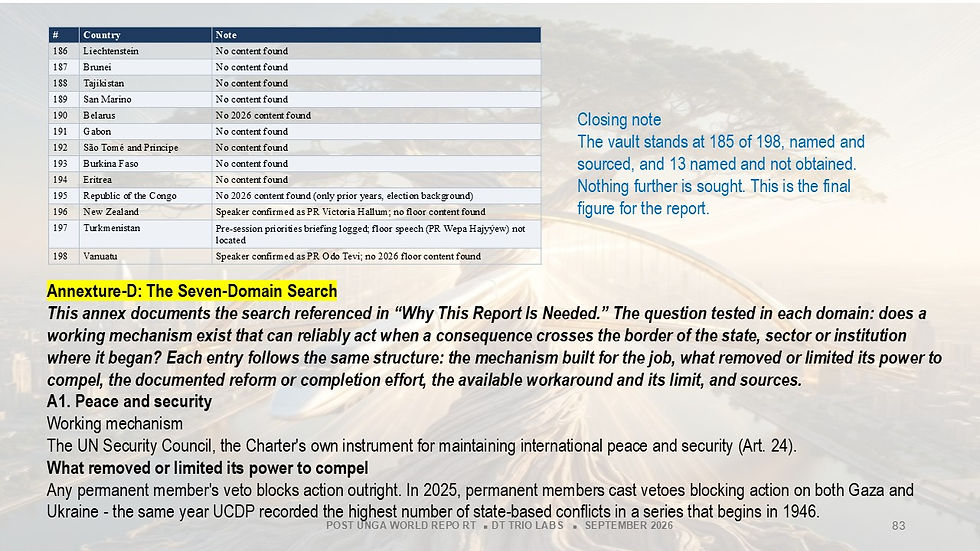
Reform or completion effort on record
Security Council reform has been on the General Assembly's agenda since resolution 47/62 in December 1992 — 34 years. Documented efforts include the African Union's Ezulwini Consensus (2005), the ACT Group's Code of Conduct (signed by 121 states), the 2024 Pact for the Future, and active 2026 proposals (a “Double Veto” system; an atrocity-crime carve-out from the veto). None has been adopted; any change to the veto itself requires ratification by all five permanent members.
Available workaround, and its limit
The 1950 “Uniting for Peace” mechanism lets the General Assembly act if the Council is blocked, but its resolutions carry no binding legal effect. A 2022 General Assembly procedure requires an automatic meeting within 10 days of any P5 veto, to scrutinise and comment — no binding obligation follows.
Sources: UN Charter Art. 24, 27; UN General Assembly resolution 47/62 (1992) and 76/262 (2022); CIVICUS Lens, “UN Security Council: reform or irrelevance” (Feb 2026); Foreign Policy, “Reforming the Security Council for a Stronger United Nations” (Sept 2025); ISS African Futures, “UN Security Council Reform”; UCDP 2025 data (published June 2026).
A2. Trade
Working mechanism
The WTO Appellate Body, the system's binding second-tier review for trade disputes.
What removed or limited its power to compel
Unable to hear a single appeal since its final seats fell vacant in December 2019 — without it, no final ruling can be made in any appealed case.
Reform or completion effort on record
In 2022, 127 of the WTO's members put forward 61 separate proposals to restore the appointment process; the United States has not supported dispute-settlement reform to date, and all 61 proposals did not proceed. WTO members committed to a fully functioning system “by 2024”; it remains non-functional as of this report.
Available workaround, and its limit
A plurilateral workaround, the Multi-Party Interim Appeal Arbitration Arrangement (MPIA), binds only its opted-in members (61 as of 2024). Where retaliation has been authorized — in only seven disputes across the WTO's history — it is widely assessed as too weak and unpredictable to compel compliance.
Sources: Congressional Research Service, “Dispute Settlement in the WTO and U.S. Trade Agreements” (2024); Wikipedia/WTO primary text on dispute settlement; European Commission, “WTO dispute settlement”; Hofstra Law Review, “Enforcement of WTO Rulings: An Interest Group Analysis”; WTO, World Trade Report 2026 executive summary.
A3. Sanctions and export controls
Working mechanism
UN Security Council sanctions authority, and, regionally, coordinated multilateral sanctions regimes (e.g. the EU's).
What removed or limited its power to compel
The same veto structure as peace and security. Since Russia's 2022 invasion of Ukraine, the Council has been unable to act on sanctions matters even where the underlying issue is unrelated to Ukraine — in June 2022 it failed to adopt a resolution strengthening North Korea sanctions after new ballistic-missile launches.
Reform or completion effort on record
No dedicated reform track exists separate from the broader Security Council reform effort documented in A1. The EU's own 20th Russia sanctions package took from 6 February to 23 April 2026 to adopt, after two member states withdrew their opposition — a reform-by-negotiation process required for every new package under EU unanimity rules.
Available workaround, and its limit
The General Assembly's 2022 veto-review procedure (as in A1) produces scrutiny and comment, not a binding sanctions outcome. Unilateral sanctions by individual blocs proceed in parallel but are not mutually binding — the same period saw the UK and EU lower an oil price cap while the US held it unchanged.
Sources: Global Investigations Review, “The Guide to Sanctions,” 6th ed.; UN General Assembly resolution 76/262 (2022); EU Council sanctions-package adoption record, Feb–Apr 2026; IRPJ, “Long-Term Consequences of the Use of Veto Power by UNSC Permanent Members” (Dec 2025).
A4. Climate
Working mechanism
The Paris Agreement's Implementation and Compliance Committee (PAICC), established under Article 15 to address non-compliance with binding procedural obligations (e.g. submitting Nationally Determined Contributions).
What removed or limited its power to compel
Non-enforcement is written into the Agreement's own decision text: the Committee “shall neither function as an enforcement or dispute settlement mechanism, nor impose penalties or sanctions, and shall respect national sovereignty” (Decision 20/CMA.1). Achievement of a country's own emissions target is not itself a legally binding or enforceable commitment.
Reform or completion effort on record
The Committee's strongest available measure — a formal public finding naming a government in breach — has never been used; in 2023 it chose a softer report even after documented filing failures. Proposals exist to strengthen the Committee's scope and to formalize climate litigation using attribution studies, but none has been adopted as of this report.
Available workaround, and its limit
The Enhanced Transparency Framework relies on public “naming and shaming” through peer-reviewed reporting, with no penalty attached. A 2026 ICJ advisory opinion found the 1.5°C target legally binding, but the same UN General Assembly resolution that requested the opinion had to separately ask the Secretary-General to report on “advancing compliance” with it — the ruling itself created no enforcement mechanism.
Sources: Climate Change News, “Paris Agreement committee snubbed over missing NDC ...” (May 2026); Legal Response International, “Options for legal remedies and procedural responses to non-compliance with the Paris Agreement”; Decision 20/CMA.1; Center for Climate and Energy Solutions, “Q&A: Understanding Paris Agreement NDCs”; Ecological Law Institute, “Paris Agreement 2026: Current Status, Legal Obligations” (June 2026).
A5. Health
Working mechanism
The WHO Pandemic Agreement, adopted by consensus on 20 May 2025 — only the second legally binding health treaty in WHO's 77-year history, built in direct response to gaps exposed by COVID-19.
What removed or limited its power to compel
The Agreement cannot open for signature until a separate, legally binding annex on pathogen access and benefit-sharing is negotiated and adopted — originally scheduled for the 79th World Health Assembly in May 2026. Ratification by at least 60 parties is required before the Agreement takes legal effect at all. During negotiation, the word “compliance” was removed from the text and replaced with “monitoring implementation.”
Reform or completion effort on record
Negotiation of the pathogen-sharing annex, the precondition for signature, remains an active, unresolved process as of this report — more than a year after the framework's own adoption.
Available workaround, and its limit
The 2005 International Health Regulations, revised and in force since September 2025, run in parallel and impose separate binding obligations, but do not resolve the Pandemic Agreement's own sequencing bottleneck.
Sources: NCBI/WHO Bulletin, “Implementation of the WHO Pandemic Agreement” (Sept 2025); Wiley, “The Pandemic Agreement: What's Next?”; WHO, “WHO Pandemic Agreement” overview page; House of Commons Library, “What is the proposed WHO Pandemic Preparedness Treaty?” (July 2026); CEPI, “The Pandemic Agreement — What it is, and what it is not.”
A6. Education
Working mechanism
No binding global mechanism exists. The nearest instruments are the Sustainable Development Goals (SDG 4) and UNESCO's convening and monitoring role.
What removed or limited its power to compel
The SDG framework is not legally binding and carries no enforcement mechanism by design; compliance rests entirely on voluntary national reporting.
Reform or completion effort on record
The global out-of-school population fell by only 1% over nearly ten years to 2024. Only 18% of SDG targets remain on track for 2030, with SDG 4 lagging particularly behind. UNESCO's own 2026–27 regular education budget was cut 24% following the exit of a major funder.
Available workaround, and its limit
The Education World Forum, the field's main global gathering, produces no binding decisions and operates through closed-door, bilateral conversation. UNESCO's Transforming Education Summit+4 (10 July 2026) is billed as potentially producing binding ministerial commitments — not yet realized as of this report.
Sources: UNESCO, “Fragmenting consensus: The multipolar turn in global education governance” (Feb 2026); UNESCO, “International cooperation on education in times of global inequality” (June 2026); Springer, “Global governance of education: The SDGs as a product and mechanism?”; IIENSTITU, “Education World Forum 2026 Analysis”; UNESCO 2026 GEM Report.
A7. Poverty and the developed/developing divide
Working mechanism
The UN's Financing for Sustainable Development framework, most recently the 2025 Sevilla Commitment, intended to mobilize the $4 trillion needed annually to meet the SDGs by 2030.
What removed or limited its power to compel
No enforcement mechanism compels the financing pledged; delivery depends entirely on the voluntary action of contributing states.
Reform or completion effort on record
The UN's own April 2026 Financing for Sustainable Development Report states the gap is widening, not closing: Official Development Assistance fell 6% in 2024 and a further 23% in 2025, developing-country debt servicing hit a 20-year high, and tariffs on Least Developed Country exports rose from 9% to 28% in a single year. The UN Secretary-General: “the global financial architecture was created for a world that no longer exists. It cannot address the challenges faced today by developing countries.”
Available workaround, and its limit
UNCTAD's Trade and Development Board convenes to discuss inequality but has no financing or enforcement authority of its own; UNCTAD confirms inequality between countries is deepening, not narrowing.
Sources: UN DESA / UN News, “Development finance gap risks reversing decades of progress” (April 2026); UnSDG, same report; DevelopmentAid.org coverage of the 2026 Financing for Sustainable Development Report; UNCTAD, “Rising inequality a blight on our development hopes”; UNCTAD, “Financing for development: Reforming global systems to drive progress.”
What the seven domains show, held together
Domain | Mechanism | Disabled / limited by | Reform effort, documented | Workaround produces |
Peace & security | UN Security Council | P5 veto | 34 yrs, unresolved (1992–) | Non-binding recommendation |
Trade | WTO Appellate Body | Vacant since 2019 (1 member's block) | 61 proposals blocked, 2022 | Opt-in-only arbitration |
Sanctions | UNSC sanctions authority | Same veto structure | None separate from A1 | Scrutiny, no binding outcome |
Climate | Paris Compliance Committee | Non-punishment written into treaty text | Never uses strongest tool available | Naming/shaming, no penalty |
Health | WHO Pandemic Agreement | Sequencing precondition unmet; “compliance” removed from text | Annex negotiation ongoing, 1+ yr | Parallel IHR, doesn't resolve gap |
Education | None binding exists | Voluntary reporting only, by design | 1% reduction in a decade | Closed-door, non-binding forum |
Poverty / development | UN Financing for Development framework | Voluntary contribution only | Gap widening per UN's own 2026 report | Discussion body, no financing authority |
Seven institutions, built at different times, for different purposes, by different people, produce the same structure independently. That recurrence is the finding this annex documents; the reading of what it requires is developed in the body of this report.
Annexture-E: Decade of Secretarial Diagnostics
To establish a baseline of data transparency and institutional accountability, this report logs a ten-year record of official opening addresses delivered by United Nations Secretaries-General. The record shows a consistent diagnostic trajectory:
2026 (António Guterres): “The fault lines in our world are widening. Cracks have become canyons... We see a world in pieces... The level of impunity in our world is politically indefensible and morally intolerable.” He added: “We cannot effectively address problems as they are if institutions don’t reflect the world as it is.”
2025 (António Guterres): “The global financial architecture was created for a world that no longer exists and cannot address the challenges faced today.” He described the drift as an environment where “cooperation over chaos is being cast aside.”
2021 (António Guterres, ‘Our Common Agenda’): “We face a stark and urgent choice: a breakdown or a breakthrough.” The Common Agenda record itself acknowledged that global risks have become networked, demanding an integrated response that legacy systems are not equipped to run.
2017 (António Guterres, initial term audit): the Secretary-General’s first operational diagnostic concluded that the international development and security apparatus was “too fragmented when coherence was required” and “too internally competitive when collaboration was mandatory.”
Strategic Impact Analysis
This decade-long tracking provides enough proof that the international system has spent years defining the boundaries of the Coherence Deficit. The leadership of the United Nations has consistently documented that the harm is networked, while the defensive machinery remains departmental. To that judgement and predicament, the Humanity 7.0 Protocol Stack is being made available as the complete architectural blueprint for nations, industries, institutions, sectors including telecommunications, businesses, transmedia and individuals across borders.
Annexture-F: Additional sources, disclaimers, acknowledgements, thank you note
Strategic References (Verified Global Records)
UN Regular Budget Framework: United Nations General Assembly, Fifth Committee, 2026 Program Budget database.
Global Conflict Demographics: Peace Research Institute Oslo (PRIO) global tracking dataset, 2026 baseline.
Macro Military Expenditure: Stockholm International Peace Research Institute (SIPRI) Yearbook, April 2026 release.
Economic Risk Metrics: Lloyd's Geopolitical Fragmentation Index & WEF Global Risks Report 2026.
Operational Core Design: DT TRIO LABS @ GVLN Peaceland, Inc. Systemic Research Archive. https://www.7girgoldenbridge.com/ https://www.kxbbioverse.com/
ACKNOWLEDGEMENTS:
This UNGA 2026 World Report is the coordinated working discipline and in alignment with self-governed standards of the HAM collaboration with the named contributing platforms: Sara Gana, Claude (Anthropic), ChatGPT (OpenAI), Grok (xAI), Gemini (Google) and Srini Gopaluni presented by DT TRIO LABS of GVLN Peaceland, Inc. (dba KXB BIOVERSE) a New York Incorporation. The ascending publicly voiced concerns around Artificial Intelligence as a potential threat is treated and incorporated natively as a functional design collective here. Thus the HAM finds its collective voice through its working discipline here to make it as humanity’s collaborative spirit.
HAM - Human, AI, and Machine intelligences coordinating as one accountable process
Chapter 10
Closing and Thank You Note
Two things are missing in the voices this report recorded: governance that performs and architecture that works. Artificial Intelligence and supply-chain disruption deepened both concerns in 2026.
Increasingly, we have noted that peace that can be traded could hold world affairs, and humanity itself, in a coherent governance accord.
Peace is neither surrender nor absence of war and it is not the private virtue of monks, saints, or dreamers.
Peace is a functional requirement of world affairs. It is the condition under which goods, law, and human life can still move when a shock does not stop at the border.
Trade spoken alone as sentiment of national need already failed to hold capability and exposure together.
Pure peace as mandate, spoken alone, breaks on contact with the year.
What must be held is the pair:
peace that can be traded, trade that does not become a weapon with no floor.
Split that pair and the standard splits with it.
Responsibility is not a private virtue. It is a functional requirement of any system whose actors are free.
Nations will not put a stamp on a holding architecture
because it is offered, or because it is kind.
They come to the table when the cost of staying fragmented overtakes the cost of a bounded rule.
Visible cost does that work. Necessity finishes it.
That makes commerce more than an economic activity.
That is not a moral story. It is how a shared road is governed.
This report made a point that commerce is one of the first operating grounds on which fragmentation becomes impossible to ignore.
And GCIGS, the global coherent integrated governance standard. is presented as that operating ground for nations and their leadership that holds their entire economic portfolios both at domestic and global level. As and when adopted, businesses, industries, institutions, sectors, borders, media, individuals, regions, continents would come under Humanity 7.0 ecosystem that is governed by its protocol compliances and council of their own members.
Once again that name, here in the closing note, becomes a reminder –
Humanity 7.0 = Interoperable Sovereignty = वसुधैव कुटुम्बकम्
ONE EARTH ACROSS SOVEREIGN BORDER LINES
The rule is for transactional safety on the surface everyone must use. GCIGS compliance protocols follow the same simple principle as the rules of a shared road. A shared road is usable because its rules apply to everyone who chooses to travel on it. You may dislike the rule, but when you want to use the road, you abide by the rule.
And this is the simplest and most direct safety precaution for humans at all levels, from governments to individuals and all commerce in between. Conflicts and Wars have ruled the human world for centuries. The United Nations General Assembly this year is an open cry of 193 nations for peace in the world, for human dignity and respect for nations, a longing for shared responsibilities with equitable growth and the need for their voices to be heard.
When humans have tested many systems that have gifted them with fragmented world on multiple accounts, Humanity 7.0 is one more that comes their way, with the potential to make an impact the world would want to keep.
Humanity 7.0 = Interoperable Sovereignty = वसुधैव कुटुम्बकम्
ONE EARTH ACROSS SOVEREIGN BORDER LINES
the global operational standards architecture
Powered by 7GIR-OS, G-Trade, GCIGS, BIOME
And the proposition is waiting to be recognized and adopted by governments (GCIGS – DoNB), institutions (G-Trade), enterprise (7GIR-OS) and civilization as a whole (BIOME).
The recorded voices of 81st General Assembly of the United Nations in this report is a tribute to those who delivered them: Kudos to every delegation, interpreter and UN staff members who carried the annual session with steadiness and diplomacy.
Thank you from the HAM Team.

Full Post UNDA 2026 World Report Downloadable here


Comments