

The Skeleton Is Missing: The $700 Billion AI Race Has No Blueprint - Critical Infrastructure Needs Critical Thinking First
Updated: Jun 10
The world has become remarkably skilled at describing the future. Building it remains a different challenge altogether. Announcements grow larger. Investments grow larger. Expectations grow larger. Yet some of the most fundamental questions of infrastructure, continuity, interoperability, and operational coordination remain unresolved. There is a missing skeleton beneath many of today's grandest ambitions.

June 09, 2026 — Presented by DT TRIO Labs Team at GVLN PEACELAND, Inc. (dba KXB BIOVERSE). DT TRIO Labs — formerly Sara TRIO Lab — is the birthplace of Meta Innovations and the STEAMATIC Era, where infrastructure meets diplomacy and capital powers global trade.
First The world is having the wrong conversation. Every headline scream about the AI spending race. Every debate asks whether trillions of dollars flowing into artificial intelligence will create a brilliant new world or collapse into the biggest financial bubble in history. But that debate misses the deeper flaw entirely. The warning sign is not that AI is growing. The warning sign is that infrastructure investment is accelerating faster than the global standards, governance mechanisms, interoperability protocols, and resilience frameworks needed to support it. We are rushing to build a giant digital brain while the physical, legal, and human systems that must support it are left behind. The giant is growing powerful muscles. The skeleton is missing.
Section 1: What Infrastructure Actually Means
Before we can understand the danger, we must define our terms - because most people debating AI infrastructure cannot even define infrastructure itself. That is intellectually upside down. Infrastructure is not a product or a technology trend. It is the foundational platform that makes everything else in society and economy possible over long-time horizons.
It operates across three core layers:
Physical Layer - power grids, ports, water systems, transport corridors, energy generation.
Economic and Industrial Layer - supply chains, logistics networks, telecom backbone, manufacturing capacity.
Digital and Institutional Layer - protocols, governance systems, financial settlement frameworks, workforce development, crisis continuity mechanisms.
True infrastructure is shared, resilient, and built for decades - not quarterly earnings cycles. It exists not to impress - but to endure.
Section 2: What AI Infrastructure Actually Is
AI infrastructure is a highly specialized, high-performance subset of digital infrastructure. It is engineered for extreme parallel computing, massive data flows, and enormous energy consumption. Its core components include compute clusters, smart-scalable data centers with advanced cooling, ultra-high-speed networking and storage, dedicated power substations, and - increasingly - orbital satellite layers.

AI infrastructure is the brain. A spectacular, rapidly evolving brain. But a brain without a body and skeleton is not powerful - it is fragile.
Section 3: The Asymmetry - What Is Being Built vs. What Isn't
In 2026, the world's largest technology companies are on track to spend a combined $650–725 billion on AI capital infrastructure.
Amazon (~$200B), Microsoft (~$190B), Google (~$180–190B), Meta ($115–135B)
and others are nearly doubling their previous years spend. The overwhelming majority flows into AI-specific infrastructure: new data center campuses, GPU procurement, power agreements, and networking. Meanwhile, broader foundational systems - resilient energy grids, cross-border governance, workforce transition programs, diversified supply chains - remain fragmented and disconnected. Some players are already pushing into orbital infrastructure (satellite constellations for compute and connectivity).
This is not science fiction anymore - it is proof we are beginning to outgrow Earth’s current capacity without first building the integrated operating system this new scale demands.

Section 4: The Coherence Gap
This asymmetry creates the Great Coherence Gap. Energy, compute, telecom, logistics, governance, trade, finance, data, mobility, infrastructure and workforce systems are not evolving together. They race at different speeds under different rules.
The gap shows up in three master zones:
Physical Zone - energy resilience, compute infrastructure, logistics. If the power grid fails, the AI melts.
Legal/Governance Zone - cross-border protocols, accountability, data and settlement interoperability.
Human Zone - workforce transition mechanisms, crisis continuity procedures.
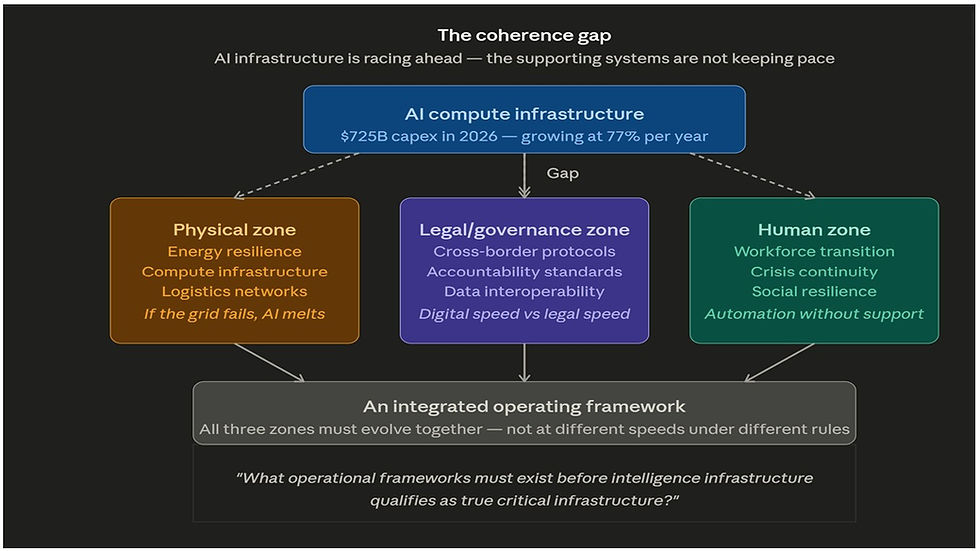
Building raw computing capacity while ignoring these zones is not ambition. It is structural fragility at civilizational scale.
Section 5: Infrastructure Exists to Enable Outcomes - What Outcomes?
Infrastructure is never the destination. It is the means. So, before we celebrate $700 billion in AI spend, we must ask:
What real outcomes is this infrastructure designed to deliver? Better healthcare? More resilient energy systems? Fairer trade? Stronger education and crisis response? The measure of success cannot be model size or compute FLOPs.
The measure must be civilization capability.
Section 6: What Responsible Scaling Actually Looks Like
This is not being anti-AI.
We are pro-responsible scaling and pro-coherence.
Responsible scaling means building the brain in parallel with the skeleton and nervous system. It means treating governance, communication, energy resilience, data, workforce transition, and interoperable corridors as co-equal infrastructure layers. The right question is not “Do you have a roadmap?”
The right question is: What operational frameworks must exist before intelligence infrastructure qualifies as true critical infrastructure?
Section 7: What Any Serious Framework Must Provide
Any serious framework must deliver:
Universal Interoperability Protocols
Cross-Border Continuity Frameworks
Energy and Compute Resilience Requirements
Workforce Transition Mechanisms
Governance and Accountability Standards
Trade and Settlement Interoperability
Crisis Continuity Procedures
Section 8: The Framework the World Needs
One ecosystem architected specifically for this coherence challenge is the 7GIR Ecosystem and Golden Bridge. Built as an integrated operating framework for the world that is already arriving, it approaches energy, telecommunications, mobility, trade, finance, governance, data, infrastructure and intelligent systems as interconnected components of a single operational reality.

Closing
The $700 billion AI race is impressive in speed and ambition. But speed without a skeleton is not progress. It is future fragility dressed up as innovation.
Critical infrastructure demands critical thinking first. The window is still open - but narrowing fast while one question remains.
When the skeleton is finally visible to all - will we say, like the emperor's new clothing, that nobody wanted to be the first to notice?
Let's have the real conversation.


Comments