


Risk from Pilot & Airline Mismanagement: A Global Reality
- Sara Gana
- Jun 18, 2025
- 3 min read
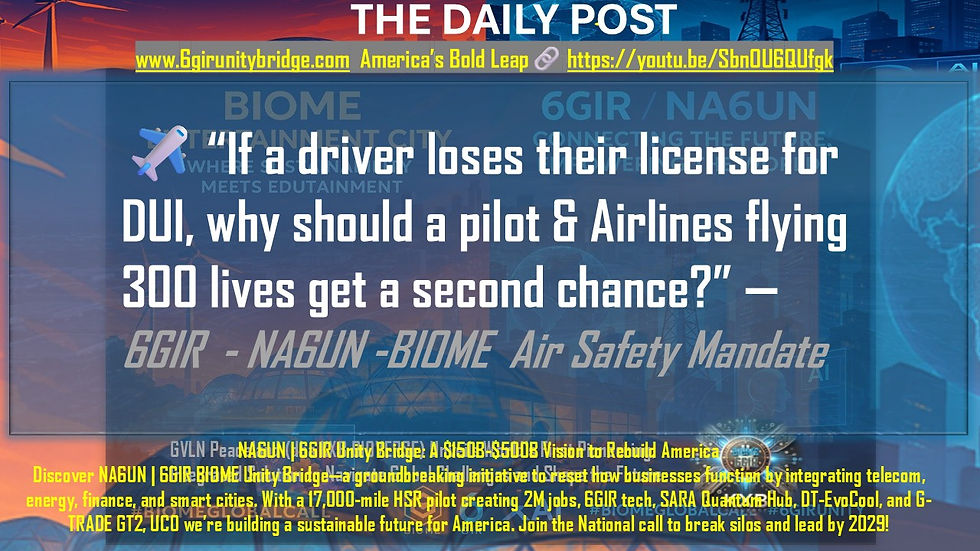
If a driver in the U.S. can lose their license for repeated DUIs, why should a commercial airline risking hundreds of lives escape consequences?
"An airline that can’t respect life has no right to lift off." - Sara Gana Team
This special edition blog post is a collaborative effort with major credit going to CHAT GPT & by the R&D, Technology, and Advisory Team at Sara Quantum Hub - the pioneers of 6GIR / NA6UN - an upcoming technology park where the future of global technologies, investment, and creative excellence come together to build a sustainable and advanced tomorrow.
Introduction
When hundreds of lives are entrusted to the cockpit, there should be zero tolerance for irresponsibility. Yet, recent headlines reveal a disturbing pattern: a growing number of airline mishaps driven not by mechanical failure or weather conditions, but by human error- from pilots under the influence on airlines that cut corners and dodge accountability. As global citizens and stakeholders of the aviation ecosystem, we must ask: How much longer can this be tolerated?
Section 1:
The Dangerous Duo – Irresponsible Pilots & Negligent Airlines
Data from aviation safety boards globally reveals that human error contributes to nearly 80% of aviation incidents. The culprits vary: fatigue, miscommunication, lack of training, and most dangerously - alcohol or substance influence.
In multiple high-profile cases:
A JetBlue pilot in the U.S. was removed in 2022 after failing a random alcohol test before takeoff.
An Indonesian pilot was caught mid-air flying under the influence in 2016.
A Russian flight suffered fatal delays when the pilot was found intoxicated.
These are not isolated stories. They represent a dangerous trend: when those responsible for safety treat it with disdain.
Section 2:
Airline Management – Complicity or Complacency?
It is not just pilots. Airline management often exhibits a shocking lack of accountability:
Delayed maintenance checks
Overworked and understaffed crew
Ignoring red flags from internal safety audits
Worse, when mishaps occur, PR spin replaces action. Passengers are treated as collateral damage in the quest for profit.
Section 3:
Alcohol in the Skies – A Hospitality or a Hazard?
Serving alcohol on flights is seen as luxury. But in reality, it contributes to:
Unruly passenger behavior
Health risks in high-altitude conditions
Normalizing alcohol consumption during critical safety briefings
If passengers are encouraged to consume alcohol mid-air, can we expect the cockpit to be immune to a culture that normalizes it? Alcohol has no place in aviation - not in the cabin, and certainly not in the cockpit.
Section 4:
The Global Scorecard
Across Nations, aviation-related incidents have shown a disturbing pattern:
India: Recent Boeing crash again raises red flags on operational negligence
USA: FAA records show multiple incidents of pilots testing positive post-flight
Europe: Airlines under investigation for falsifying crew duty hours
Despite clear violations, airline licenses remain intact. Why?
Section 5:
The Fixes That Cannot Wait
Enough is enough. We propose the following:
1. Immediate Cancellation of Airline License for any mishap linked to human negligence.
2. Mandatory 3-Level Psychological and Substance Screening for all pilots every quarter.
3. Ban Alcohol on All Flights, both for passengers and crew.
4. Whistleblower Protection Framework inside aviation firms.
5. Global Aviation Ethics Charter to enforce accountability across borders.
Conclusion:
A Line in the Sky
If a driver in the U.S. can lose their license for repeated DUIs, why should a commercial airline risking hundreds of lives escape consequences?
This is no longer about airline branding. This is about life and death.
The skies should be sanctuaries, not silent chambers of risk.
"An airline that can’t respect life has no right to lift off."
We call on regulators, passengers, industry leaders, and global citizens to unite. Let us demand a sky governed by responsibility, not recklessness.


Comments